

I am passionate about the study of biodiversity, particularly entomology and botany. My work involves researching insects and plants, primarily in Europe, Africa and the Dutch Caribbean. My goal is to make biodiversity more accessible by sharing knowledge about species, describing new ones and using maps to illustrate areas of high biodiversity. In the Netherlands, I primarily work on species knowledge (faunistics) and monitoring methods. In Africa and the Caribbean Netherlands, analyses of biodiversity and the description of new species are also important components of my research, in addition to faunistics and floristics.
Keywords
Insects, beetles, crickets, wasps, Leguminosae, Begonia, Achariaceae, Orthoptera, Coleoptera, Gabon, Africa, biodiversity assessment, Netherlands, Saba, Buchnerodendron
Research interestsEntomology
Within the field of entomology, my primary focus is on the insect fauna of the Netherlands and the Dutch Caribbean islands. My work involves extensive research on grasshoppers, crickets and related orders, as well as wasps and beetles. An important recent initiative is Project: Entomofauna and Flora of the Caribbean Region. During fieldwork on Bonaire and Saba, many new insect species were discovered on these islands. These islands are also home to several species that have never been described before. This project involves describing these species and writing publications to help identify those found here.
In the Netherlands, my focus is on insects, particularly beetles, and optimising various collection techniques for research purposes. As far as Africa is concerned, I restrict my research to grasshoppers and crickets.


Research interestsBotany
My botanical research focuses strongly on African flora. I have extensive knowledge of the flora of Gabon, where I conducted fieldwork for more than two years. I am currently working on Begonia, species from the legume family (Leguminosae), particularly trees from the subfamily Detarioideae, and a number of genera from the Achariaceae. In 2024, I completed a study on Cassytha, parasitic climbing plants from the laurel family. My work focuses on both taxonomy (describing new species and creating keys) and biodiversity studies. I process data from collection specimens to make statements about the distribution of African botanical diversity, thereby contributing to the assessment of global plant diversity.


Currenttopics
In addition to my taxonomic work, I am involved in several larger projects. Projects I am working on include:
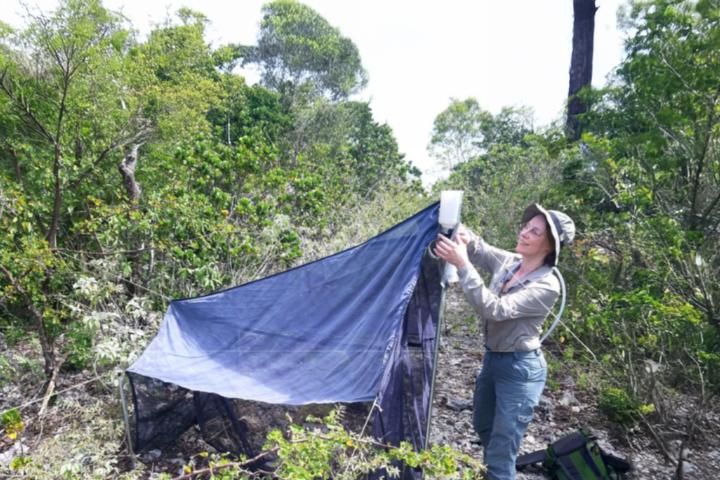
Entomofauna and flora Caribbean
ARISE: knowing Nature in the Netherlands
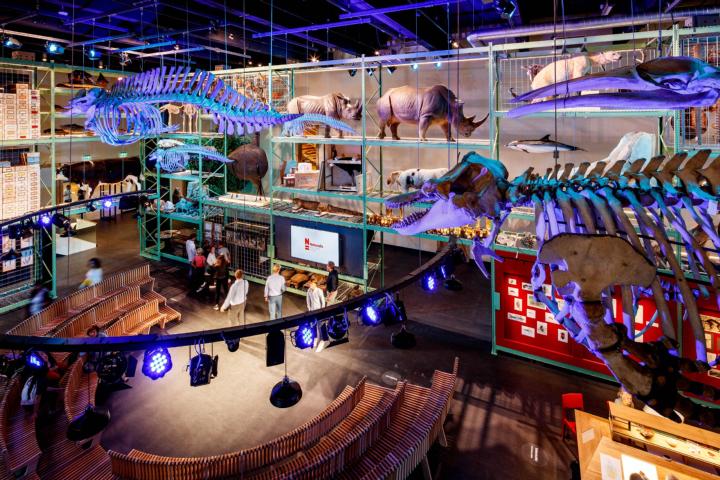
LiveScience
Keypublications
- Wieringa JJ., Simons, ELAN 2024. Cassytha (Lauraceae) in Africa and the description of a new species from Gabon. Blumea 69: 201-210. 10.3767/blumea.2024.69.03.01.
- Droissart V, Dauby G, Hardy OJ, Deblauwe V, Harris DJ, Janssens S, Mackinder BA, Blach-Overgaard A, Sonke B, Sosef MSM, Stevart T, Svenning JC, Wieringa JJ, Couvreur TLP. 2018. Beyond trees: Biogeographical regionalization of tropical Africa. Journal of Biogeography 45: 1153-1167. 10.1111/jbi.13190
- Jung M, .., Wieringa JJ, et al. 2021. Areas of global importance for conserving terrestrial biodiversity, carbon and water. Nature Ecology & Evolution 5: 1499-1509. s41559-021-01528-7
- LPWG. 2017. A new subfamily classification of the Leguminosae based on a taxonomically comprehensive phylogeny. Taxon 66: 44-77. 10.12705/661.3
Teaching
An important part of my work involves sharing my knowledge. I deliver lessons and lectures on flora and fauna, teaching students how to identify plants and insects, and demonstrating where and how they live in the field.
- I regularly assist with the “Biodiversity and Ecology” course at the University of Amsterdam. During the first two weeks, the focus is on recognising insect groups and plant families. First, we cover this topic through lectures and practical sessions using binoculars. Then, we visit different types of vegetation in the Netherlands to demonstrate local biodiversity and the effects of ecological differences. The second half of the course involves a field study in South Limburg, where students collect entomofauna samples and record vegetation data independently. During the fourth week, the samples are processed further and all the data is analysed and interpreted.
- For the Biodiversity course at Leiden University, Aglaia Bouma and I teach a shortened version of the insect section of the UvA course, focusing on sampling techniques.
- In addition to teaching, I supervise BSc and MSc students, helping them formulate and carry out their own research projects within the field of biodiversity.
- For the Biology Olympiad, I lead an excursion focusing on the identification of Dutch plants.


In de media
In addition to my academic work, I believe it is important to make biodiversity accessible to a wide audience. I regularly join Aglaia Bouma at LiveScience (in the museum) to bring the world of insects closer to the public. During these sessions, I prepare insects for the public, explaining the diversity and importance of these fascinating creatures.
- Jan talked about the national bee count on Jeugdjournal. Want to see more? Watch the clip here (in Dutch).
- Jan was a guest on Vroege Vogels to talk about the Insect of the Year 2025 election (in Dutch).
- Article from Trouw, entitled 'You can kill an Asian hornet, but not a European one. But try telling them apart' (in Dutch).
